Hey there, if you’ve ever watched a semi-trailer rumble down the highway—whether you’re waiting at a truck stop for a coffee, stuck at a railroad crossing, or just peeking over a fence at a yard full of them—you’ve probably wondered how that giant thing actually works. I’m Jake, and I’ve been running a semi-trailer supply business for 12 years now, so I’ve taken apart (and put back together, more times than I can count) almost every part of these rigs. Let me break it down for you like I would for a new driver picking up their first trailer, no fancy jargon or textbook stuff, promise. Semi-trailer

First off, let’s get one tiny myth outta the way: a semi-trailer isn’t the whole truck. It’s just the big box (or flatbed, or refrigerated unit) that hitches to the front part—the cab-and-chassis combo, what us folks call the “tractor.” That’s why it’s “semi”: it only supports part of its own weight, not all of it. The tractor pulls it, but the trailer’s front end rests on the tractor’s fifth wheel, that big round metal plate you see sticking out of the back of the cab. That fifth wheel isn’t just a hook, by the way—it’s got locking jaws that clamp down on a kingpin on the trailer’s front, so the whole thing doesn’t come unhitched mid-road trip. You think it’s as simple as slamming the trailer into the tractor? Nah, there’s a whole process to line ‘em up, check the locking pin, test the air brakes before you even move an inch.
Now, let’s talk about how the trailer itself gets around once it’s hitched. Most standard dry van trailers (the plain box ones that carry everything from furniture to Amazon packages) have three axles at the back, right? Each axle’s got two wheels, so that’s 12 wheels total on the trailer, plus the tractor’s 10 or so. The axles aren’t just sitting there—they’re connected to the trailer’s frame, that steel backbone that runs the whole length of the thing. That frame is heavy duty, obviously, ‘cause it’s holding up 40,000 pounds of cargo legally (and way more if someone’s cutting corners, which we hate).
What makes the trailer move, though? Wait, no—the tractor pulls it, but how does the trailer’s steering work when you turn? Oh right, semi-trailers don’t really steer on their own at low speeds (for jackknifing risks) except for some fancy spread axle or steerable lift axles we install for heavy loads. Most of the steering is all on the tractor’s front wheels. That’s why you see trailers fishtailing a little when the truck’s turning sharp—there’s a gap between the tractor’s back wheels and the trailer’s front, so when the cab turns left, the trailer has to swing wide to the right to not clip the curb. That’s not a bug, that’s just physics we live with, and it’s why truckers take wide turns.
Okay, let’s get to the stuff that actually makes a trailer do what it needs to do: the systems. Number one on the list is the air brake system. You probably know regular cars have hydraulic brakes, but semi-trailers run on compressed air—way more reliable for heavy loads. Here’s how it works, super simplified: the tractor has an air compressor that pumps air into tanks. When the driver hits the brake pedal, it sends that air through lines (we call ‘em gladhands, those big round fittings you connect between tractor and trailer) to the trailer’s brake chambers. Each wheel has a brake chamber that pushes a rod to activate the brake pads or shoes against the drum or rotor.
Wait, and if the trailer ever disconnects, those air lines automatically trigger the emergency brakes. That’s a safety thing we’re required by law to test every time we service a trailer. I’ve seen a trailer roll away from a loading dock once ‘cause the gladhand came loose—scary, and totally preventable, which is why we stress checking those connections so hard. No one wants a runaway semi on their hands.
Another key system is the suspension. If you’ve ever ridden in a semi and felt like you’re on a rock at a stop sign, wait till you’re in the trailer (I’ve hauled produce a few times to test our refrigerated units) and felt how rough it can get. The suspension is what cushions the load and keeps the trailer wheels on the road, even over potholes or speed bumps. Most standard trailers use leaf springs—long, curved steel plates stacked together—while some heavy haul trailers use air suspensions, which adjust the height of the trailer based on load. Air suspension is great for fragile cargo, like electronics, ‘cause it cuts down on vibration. We started installing more air suspension trailers about 8 years ago, and customers go crazy for ‘em ‘cause they reduce damage claims.
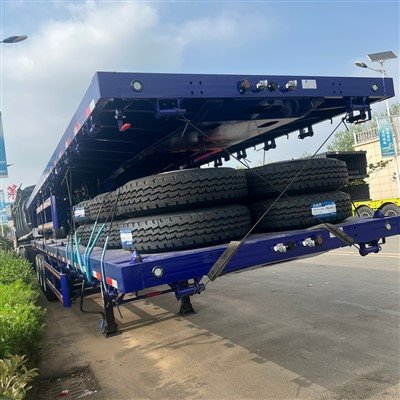
Let’s talk about different types of trailers too, ‘cause not all semi-trailers are the same. The dry van I mentioned earlier is 70% of what we supply—solid walls, locked doors, perfect for general freight. But if you need to carry construction equipment, pipes, or cars, you get a flatbed. Flatbeds don’t have sides, so you gotta strap the load down, but we install extra tie-down points along the rails for that. Then there’s refrigerated trailers (reefers) for food, meds, anything that needs temperature control. Those have their own diesel-powered AC unit on the front of the trailer, and we calibrate those to hold temps from -20°F for frozen meat to 70°F for fresh produce. I once had a customer call at 2 a.m. ‘cause their reefer unit died mid-route—we shipped a replacement part overnight, and by sunrise, they were back on the road. That’s the kind of service we pride ourselves on, not just selling trailers, but supporting ‘em.
Flatbeds, reefers, dry vans—all of ‘em have that frame, axles, brakes, suspension foundation. The big differences are in the body and the auxiliary systems. For example, a tanker trailer for gas or milk has a round steel tank mounted on the frame, and it has pumps to load and unload the liquid. We only build those with stainless steel, ‘cause anything else corrodes fast and can contaminate the cargo. And container chassis—those are the ones that hold shipping containers from ports, right? They’re super lightweight, so truckers can maximize their load weight without overstepping road limits.
Wait, I wanna get into the engineering a little, ‘cause I know a lot of guys ask “how do you fit so much stuff on a trailer without it tipping?” The secret is weight distribution. A semi-trailer’s total weight can’t be more than 80,000 pounds in the US (state lines have different rules, but that’s the standard), and you gotta spread that weight evenly over the axles. If you stack all the heavy cargo at the back, the front axles might lift, making steering impossible. If you put too much weight on the trailer’s first axle (the one closest to the tractor), that can damage the fifth wheel or cause jackknifing. We work with every customer to map out their load plan when we sell ‘em a trailer—we don’t just hand over a unit and say “good luck.” If someone’s new to hauling, we’ll even walk ‘em through basic weight distribution tips over a beer at our yard. Been doing that for years, builds trust.
Another thing people don’t realize: trailer tech’s changed a lot lately. We used to only have basic lighting, now we add LED lights that last way longer, and brake sensors that send alerts to the driver if a brake is failing. We also install tire pressure monitoring systems (TPMS) that tell you if a tire is underinflated, which is huge—underinflated tires cause blowouts, which are a top cause of semi accidents. Last year, we started adding GPS trackers as a standard add-on for all our trailers, so customers can see where their cargo is at all times. It’s not just a fancy feature; it’s a safety and security thing.
Now, let’s bust another common misconception: a lot of people think trailer maintenance is optional. Nah, it’s the only thing keeping the trailer working. Every 6 months, we do a full inspection: check the brakes, air lines, suspension, tire tread, the fifth wheel’s jaws, the frame for cracks. I’ve seen trailers go way past their 10-year lifespan because their owners kept up with maintenance, and I’ve seen brand new trailers get wrecked ‘cause someone skipped a brake check. We offer maintenance plans for all the trailers we sell, too—pickup and dropoff at our shop, so the customer doesn’t have to leave their yard for 2 hours. That’s the stuff that keeps rigs on the road for decades.
Wait, let’s get back to the “how it works” core, cause I don’t wanna ramble too much. The whole system is a team: tractor provides power and steering input, fifth wheel connects and transfers weight, trailer frame holds everything together, axles and wheels move it, air brakes stop it, suspension keeps it stable, auxiliary systems (refrigeration, tie-downs, tank pumps) do the specific job the trailer was built for. None of it works alone. You can have the fanciest fifth wheel in the world, but if your air line has a leak, the brakes won’t engage. You can have a steel frame, but if your suspension’s shot, the ride’ll be so rough your cargo breaks.
And for us as a supplier? We don’t just sell a metal box with wheels. We build trailers that work for what our customers need. If a small local moving company needs a 28-foot straight trailer (wait, no, semi-trailers are mostly 53 feet now, but we do 28-foot pup trailers too for short hauls)—we tailor it to their needs. If a national grocery chain needs reefers that can run 24/7 without breaking down, we spec the most reliable units we can find, with backup parts available nationwide. I’ve been in this business long enough to know that a trailer that breaks down costs a customer way more than the price of a good trailer upfront. That’s why we don’t cut corners on materials or assembly.
If you’re a fleet owner, an independent driver looking to upgrade, or a logistics manager needing a new trailer for your line of work—let’s chat. I know how overwhelming it can be to pick the right semi-trailer: different lengths, different types, different weight limits, all that jargon. I’ll sit down with you, show you the units in our yard, walk through the pros and cons of each, answer every stupid question you have (I’ve heard ‘em all, trust me). We’ve got new trailers and well-maintained used ones, so no matter your budget, we’ve got something that’ll work for your operations. The road’s tough enough—your trailer shouldn’t be another thing to stress about.
Flatbed Semi-trailer 参考文献
- Commercial Vehicle Safety Alliance. (2022). Heavy Duty Vehicle Brake System Inspection Guidelines.
- Technology and Maintenance Council. (2021). Semi-Trailer Suspension and Weight Distribution Best Practices.
- Federal Motor Carrier Safety Administration. (2023). Commercial Motor Vehicle Trailer Safety Standards.
Jining Yaochi Automobile Trading Co., Ltd.
With abundant experience, we are one of the most professional semi-trailer manufacturers in China. Please feel free to buy cheap semi-trailer made in China here from our factory. Quality products and reasonable price are available.
Address: Liangshan Industrial Park, Jining City, Shandong Province, China
E-mail: Yzhiying23@gmail.com
WebSite: https://www.yaochitruck.com/
