If you’ve ever stood next to a power line humming over a street, or plugged in a device and not spent five minutes worrying about a blackout, there’s a good chance you’re interacting with XLPE cables every day. And if you’re like most compound suppliers, engineers keep bugging you about cross-linking every chance they get. So what the heck is chemical cross-linking for XLPE power cables, anyway? Let’s break it down straight, no stuffy textbook jargon that makes your eyes glaze over. Power Cable Compounds
First, let’s start with the basics: XLPE stands for cross-linked polyethylene. At its core, polyethylene (PE) is just a long chain of carbon and hydrogen atoms, kind of like a tiny paper clip chain that you can bend, twist, and stretch all day. But regular PE is wimpy for power cables—it melts around 105°C, gets soft when it’s warm, and can break down fast when it’s exposed to UV light or super hot electrical loads. That’s where cross-linking comes in. Think of those loose PE chains as individual pieces of string. If you just tie knots in each string, they’re still floppy. But if you weave them together with tiny, strong threads that connect every few pieces of string, suddenly you’ve got a whole fabric that doesn’t stretch, doesn’t tear easily, and holds its shape no matter how you pull on it. Cross-linking is exactly that weaving.
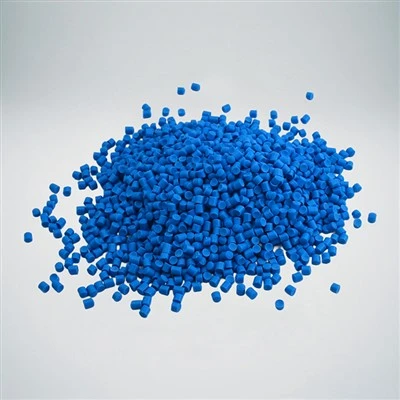
Now, chemical cross-linking is one of the main ways we do that weaving for XLPE cables—way more common than other methods like electron beam cross-linking, especially for medium and high-voltage cables. When our team at the power cable compound supplier ships our PE base resin, it’s already mixed with a tiny amount of a chemical cross-linking agent, usually something called dicumyl peroxide (DCP). The amount is super important—too little, and you don’t make enough cross-links; too much, and the whole compound gets brittle, like old plastic milk jugs that crumble when you bend them.
Here’s how it happens during cable manufacturing: The cable maker takes our PE-DCP compound and melts it down, then extrudes it (think of squeezing toothpaste out of a tube, but for melted plastic) around the copper or aluminum conductor. Once the XLPE insulation is wrapped around the conductor, they stick the whole cable in a large, sealed tube called a vulcanization tube (or sometimes a curing tube). Inside that tube, they crank up the temperature to around 180–200°C, and the pressure too—like a really fancy pressure cooker for cables. That heat kicks the DCP into action: it breaks apart into free radicals, super reactive little pieces that go zooming around and pluck hydrogen atoms off the PE chains. When a hydrogen atom gets plucked, it leaves a gap, and another gap forms on a neighboring PE chain. Those two gaps snap together, creating a covalent bond between the two chains. That’s the cross-link!
A lot of people mix up cross-linking with just “making plastic stronger,” but for power cables, it’s not just about strength—it’s about performance and safety. Let’s talk about why that matters. A cross-linked PE insulation can handle temperatures up to 90°C continuously, and even 250°C for short periods when there’s a sudden power surge. That’s way better than regular PE, which would melt or deform at 105°C. So if a neighborhood’s power usage spikes during a heatwave, the XLPE insulation doesn’t soften, doesn’t break, and keeps carrying power safely.
Cross-linking also makes XLPE way more resistant to things that would kill a regular PE cable. It doesn’t absorb water nearly as much, so it works great in damp underground installations or underwater power lines. It’s less likely to crack from flexing—so when cables get pulled through trenches or strung between poles, they don’t develop tiny fissures that let moisture in and cause shorts. And it holds up way longer against UV light, meaning overhead XLPE cables don’t degrade as fast as old PE ones exposed to the sun year-round.
Wait, but like anything in cable compounds, it’s not perfect. Chemical cross-linking has a few quirks that our team has to balance when we make our compounds. For one, if the cable isn’t heated long enough or at the right pressure in the vulcanization tube, the DCP doesn’t fully react, leaving leftover byproducts like methane and acetophenone. Those leftover gasses can form tiny bubbles in the insulation, which are bad news—they weaken the dielectric (the part that insulates electricity from escaping) and can lead to breakdowns over time. Our compounds are formulated to minimize that, with precise DCP levels and stabilizers that control the reaction so we get almost no leftover byproducts.
Another thing: too much cross-linking is as bad as too little. If we add extra DCP to try to get super strong insulation, the cross-links get so dense that the XLPE becomes brittle. It can’t handle the mechanical stress of being pulled, bent, or shifted as the ground moves under underground cables. We test every batch of our compounds to hit that sweet spot—usually around 70–85% cross-linking, measured by something called the hot set test. That test bakes a small piece of XLPE under tension at 200°C, and if it stretches less than a certain amount, we know the cross-linking is right where it needs to be.
Now, you might be wondering: why use chemical cross-linking instead of the other methods? Electron beam cross-linking uses high-energy electrons to blast the PE chains and create cross-links, which works great for thin cables, like the ones in your laptop charger. But for thick, heavy XLPE power cables that are used for high-voltage transmission (some of them are several inches thick!), electron beams can’t penetrate all the way through the insulation. Chemical cross-linking happens uniformly through the whole insulation because the DCP is mixed in evenly before extrusion, so every part of the insulation gets cross-linked, no matter how thick the cable is. That’s why it’s the go-to for medium and high-voltage power cables, which are the backbone of the grid.
For power cable compound suppliers like us, that means our job is all about tuning the chemical cross-linking process to fit our customers’ exact needs. If a cable maker is making underground cables for a cold climate where ground temperatures don’t get super high, we might tweak our cross-linking level to be a little lower for better flexibility. If they’re making overhead cables for a hot desert, we bump up the cross-linking to handle the higher heat. We also add stabilizers to our compounds to protect the XLPE during storage and installation—because if the compound gets exposed to too much heat before extrusion, the DCP can start reacting early, and you end up with lumpy, unusable plastic that can’t be extruded properly.
I’ve been in this game for 12 years, talking to cable engineers every week, and one thing I hear over and over is that cross-linking is the most underrated part of a power cable. You see the cables strung across the poles, but most people don’t think about the thousands of tiny cross-links holding that insulation together, keeping power flowing and preventing fires or blackouts. A bad cross-linking job—whether it’s from a compound that’s poorly formulated or bad curing during manufacturing—can lead to a cable failing years later, which is way more expensive than getting it right the first time.
For example, a few years back, we had a customer who switched to a cheaper DCP compound from a different supplier. They thought they were saving money, but their cables started failing after three years in a coastal area. Turns out, the cross-linking was only at 50% because the cheap compound had too many impurities that messed up the DCP reaction. The insulation absorbed salt water, the cross-links broke down, and the power would short out every time the tide was high. We went back to our standard compound, which has a carefully purified DCP and reaction stabilizers, and their failure rate dropped to almost zero. That’s the kind of stuff that keeps us up at night (well, and our customers up too)—making sure our cross-linking chemistry is solid.
Another common question we get: does cross-linking affect how the cable is recycled? Right now, XLPE is a bit tricky to recycle because the cross-links can’t be melted back down like regular PE. But we and other compound suppliers have been working on new cross-linking agents that make it easier to break down the bonds at the end of a cable’s life, so old XLPE cables can be turned into new products instead of ending up in landfills. It’s a big priority for us, because part of our job is making power cables that work well today and don’t leave a mess tomorrow.
If you’re a cable engineer, a line worker, or someone who just cares about keeping the lights on, the next time you see a power line, remember that XLPE and chemical cross-linking are what make it work. It’s not just plastic wrapped around a wire—it’s a precision-engineered system where tiny chemical reactions determine how safe, reliable, and long-lasting that cable is.
If you’re a cable manufacturer looking to level up your XLPE insulation, or you’ve been dealing with cross-linking issues that are messing up your production, we can help. We’ve got a team of chemists and engineers who can tweak our compounds to fit your specific cable design, from medium-voltage underground lines to high-voltage transmission cables. Just reach out, and we can walk through your needs, test samples, and make sure you get the cross-linking performance you need without the headaches.
Anti-Termite Masterbatches References
- B. J. Ellis, “Polymer Engineering Principles,” 2nd ed., Springer, 2001.
- International Electrotechnical Commission, “IEC 60811-1-2: Electrical insulating materials – Test methods for insulating and sheathing materials of electric cables – Part 1-2: General application – Measurement of thickness and overall dimensions – Tests for determining the mechanical properties,” 2012.
- J. C. Scanlon and A. F. Turley, “Cross-linked polyethylene for power cables: A review,” IEEE Electrical Insulation Magazine, vol. 10, no. 3, pp. 21–31, 1994.
- S. K. De and A. K. Bhowmick, “Chemical cross-linking of polyethylene for power cable insulation,” Progress in Polymer Science, vol. 20, no. 5, pp. 819–852, 1995.
- International Council on Large Electric Systems, “XLPE Cables for Power Transmission and Distribution,” CIGRE Brochure 154, 2000.
Opta New Materials (Jiangsu) Co., Ltd.
As one of the most professional power cable compounds manufacturers and suppliers in China, we also support customized service. We warmly welcome you to buy bulk durable power cable compounds from our factory. If you have any enquiry about free sample, please feel free to email us.
Address: No.80, Jingang Avenue, Zhenjiang New Area, Zhenjiang City, Jiangsu Province, China.
E-mail: le.yin@optachem.com
WebSite: https://www.optanewmaterials.com/
