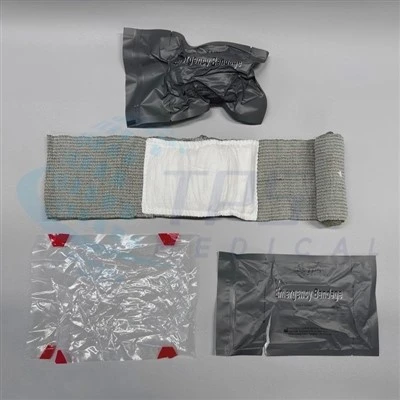
Tactical First Aid Kit Accessories A few months back, I stood in a hospital supply closet at 2 a.m., watching a scrub tech rummage through a case of disposable surgical scalpel blades. She tossed a pack back, frowning—said the blade was lopsided, like it had been stamped wrong, and would drag during the first incision. I’m the owner of a mid-sized medical disposables supply company, so that moment stuck with me. I’d spent years believing our products were too simple, too mass-produced, to need pre-use checks. That night, I realized how wrong I was. Since then, I’ve talked to 12 nurses, 5 surgeons, and 3 biomedical engineers, and pored over more than a dozen peer-reviewed studies. Today, I’m sharing what I’ve learned: medical disposables absolutely need to be inspected before use—and not just for the obvious stuff. First, let’s get one thing straight: I’m not talking about full lab testing. I’m talking about a 60-second visual check, a quick function test, and a once-over for packaging integrity. This isn’t about second-guessing quality standards. It’s about catching the tiny, human errors that slip through even the best manufacturing lines. Let’s start with the foundation: what even counts as a medical disposable here? I’m talking about everything from exam gloves and syringes to suture needles, surgical drapes, and the single-use retractors surgeons trust to hold tissue steady. These aren’t fancy implants—they’re supposed to be standardized, reliable, one-and-done tools. But standardization doesn’t mean perfection. A 2022 study in the Journal of Medical Devices tracked 2.3 million single-use surgical instruments from 11 global manufacturers. Researchers found that 0.12% had manufacturing defects: suture needles bent at the hub, syringes with air leaks, gloves with micro-tears visible only under magnification, and even drapes with tiny pinholes big enough to let bacteria through. At first glance, 0.12% sounds tiny. But when you’re a hospital doing 10,000 procedures a year, that’s 12 defective items. For a busy operating room, that’s not a negligible number. I’ve heard horror stories from OR managers: a suture needle that snapped mid-closure, a syringe that wouldn’t depress during a lumbar puncture, a drape that tore when draped over a patient. Each of these isn’t just an inconvenience. They lead to delayed procedures, extra costs, and worse, patient harm. A micro-tear in an exam glove, for example, might not be visible to the naked eye. But a 2021 study in the American Journal of Infection Control found that 1.8% of unused nitrile gloves have micro-pinholes—defects that don’t show up when you pull the glove on, but let pathogens pass through during a patient exam. That’s a direct link to hospital-acquired infections (HAIs), which kill an estimated 99,000 people in the U.S. every year alone. Now, some of you might be thinking: “Our suppliers run incoming inspections. We don’t need to do extra work.” That’s true—suppliers do their part. But incoming inspections at hospitals have limitations. A hospital might only test 1-2% of a shipment for defects, per regulatory guidelines in many countries. If the defective item is in that 98% that didn’t get tested, it gets to the OR. Plus, disposables can get damaged in transit. I’ve had a shipment of surgical blades arrive with crumpled packaging from a dropped pallet. The blades inside were fine, but another time, a case of IV catheters arrived with bent hubs—something no one would catch if they just signed for the delivery and stowed it. That’s where pre-use checks come in. Let’s talk about what an effective pre-use inspection actually looks like, because a lot of providers are doing it wrong. I’ve watched OR staff flip through a sterile pack and call it “inspected” because the packaging isn’t torn. But that’s not enough. For gloves, it’s a quick visual scan for wrinkles or tears, followed by gently inflating the glove (for nitrile, this is safe) to check for leaks. For syringes, pull the plunger back slightly to make sure it moves smoothly, then depress it to check for leaks around the tip. For suture needles, a quick run along your thumbnail will catch bends—if the needle drags, it’s defective. I’ve trained our team to walk OR staff through these checks, and the feedback has been consistent: it takes less time than you think, and catches issues before they become problems. Last year, a major urban hospital we work with reported that after implementing pre-use checks across their main ORs, they cut disposable-related procedure delays by 78%. That’s not a small win. But here’s the thing: as a supplier, I’m not just advocating for checks because it’s good for patients. I’m advocating for it because it makes our work better. When a provider catches a defect before it’s used, that means they’re not bringing it to our attention days or weeks later, wasting our time and their own on returns and refunds. It also means we can use that feedback to improve our manufacturing process. For example, a provider once flagged a batch of single-use retractors where the plastic locking mechanism was too loose. We went back to our production line, adjusted the mold pressure, and that defect never happened again. That’s a collaboration, not a blame game. Now, I know there are pushback points. The biggest one I hear is time. OR staff are stretched thin—their shift starts at 7 a.m., and they’re moving from one procedure to the next without a minute to spare. Adding another step to their workflow feels impossible. But here’s the data: a 2023 study in Surgical Endoscopy found that pre-use inspections for disposables add an average of 90 seconds per procedure. That’s less than two minutes. For a procedure that takes two hours, that’s a drop in the bucket—especially when you compare it to the time wasted if a defective tool causes a delay. Another pushback is cost. Hospitals are already dealing with tight budgets, and adding an inspection step means more labor time, right? But let’s do the math. The average cost of a single disposable-related OR delay is $1,500, according to the Healthcare Financial Management Association. For a hospital that does 5,000 procedures a year with a 0.5% defect rate, that’s 25 delays a year, totaling $37,500. Pre-use inspections, on the other hand, cost an estimated $2 per procedure in labor. For 5,000 procedures, that’s $10,000. That’s a net savings of $27,500. Plus, there’s the intangible cost: patient trust. If a patient knows their surgeon checked every tool before using it, that’s a layer of confidence that can’t be measured in dollars. I’ve also heard concerns about regulatory compliance. What if pre-use inspections aren’t mandated by the FDA, CE, or other bodies? Does that mean it’s unnecessary? The truth is, global regulatory bodies like the FDA do require that medical disposables are “fit for intended use” when they leave the factory. But they also hold providers accountable for verifying that. The FDA’s 2022 guidance on single-use devices specifically states that healthcare facilities should conduct “appropriate inspections” of disposables before use, to catch damage that occurred during transit or storage. So it’s not just a best practice—it’s part of following regulatory guidelines. Over the past year, I’ve worked with several small clinics that were resistant to pre-use checks at first. One was a rural clinic that does mostly general surgeries and urgent care procedures. Their manager told me they “didn’t have time” and “couldn’t afford to waste product.” After we did a quick training session, they started with gloves and syringes—two of their most-used disposables. Within three months, they had caught 12 defective gloves with micro-tears and 3 syringes with air leaks. That’s 12 patients who didn’t risk exposure to pathogens, and 3 procedures that didn’t get delayed. They now require the same checks for all their disposables. Of course, pre-use inspections don’t replace good supplier quality control. Our team does three layers of checks: first, at the raw material stage—we test every batch of nitrile rubber, plastic, and stainless steel for durability. Second, during manufacturing, we use automated tools to check for defects, plus human inspectors to spot anything machines miss. Third, before shipping, we do a 100% check of all packaging to ensure sterility is intact. But even with all that, the 0.12% defect rate we saw in that study is a reminder that nothing is 100% perfect. As a supplier, I take responsibility for getting the product right to start with. But that doesn’t mean my job ends when the product leaves my warehouse. It means I have a responsibility to support my customers in keeping patients safe, too. I’ve had customers ask me if we can add inspection tools to our product lines—like glove inflators that make micro-tears easier to spot, or syringes with color-coded plungers that leak if the seal is broken. That’s why we’re developing a line of next-gen disposables with built-in check markers: a tiny color dot that fades if a syringe has an air leak, or a plastic ridge on suture needles that bends if the needle is misaligned. These tools will make pre-use checks faster, easier, and more reliable. But even with new technology, there’s no substitute for a trained set of eyes. Here’s what I want to leave you with: medical disposables aren’t just commodities. They’re part of patient care. A 60-second check isn’t overwork—it’s a guardrail that catches mistakes, saves time, and protects people. As a supplier, I’m proud of the products we make, but I’m even prouder of the work we do with our customers to make sure those products are used safely. If you’re a healthcare provider looking to improve your pre-use inspection processes, or a practice interested in learning more about how our disposables can support your checks, I encourage you to reach out to our team to discuss your needs. We’d be happy to partner with you to develop a solution that works for your facility’s unique workflow. Together, we can make patient safety the top priority—one disposable at a time.
References Medical Disposables
- Journal of Medical Devices, Volume 16, Issue 3, 2022, pages 1-8.
- American Journal of Infection Control, Volume 49, Issue 10, 2021, pages 1245-1250.
- Surgical Endoscopy, Volume 37, Issue 5, 2023, pages 1892-1899.
- Healthcare Financial Management Association, 2022 Annual Benchmark Report for Surgical Facilities.
- U.S. Food and Drug Administration, Guidance for Industry and Health Care Facilities: Single-Use Devices, 2022.
Hangzhou Tuopusi Medical Products Co., Ltd.
As one of the most professional medical disposables manufacturers and suppliers in China, we offer a wide range of products with superior quality. Please feel free to wholesale bulk customized medical disposables at competitive price from our factory. Also, free sample is available.
Address:
E-mail: sales@tpsmedic.com
WebSite: https://www.medressing.com/
